I exported a real CAREL c.suite application to STone. Here is what the Export button actually gives you
Contents
c.suite is on its way out. CAREL’s Product Termination Notice for c.pCO controllers on the c.suite OS cites the Cyber Resilience Act, and the official bridge to the new platform is the Export to STone function in c.suite 5.3.18. The release notes call the FBD part a “first draft”. I wanted to know what that button really delivers on a real application, not on a demo, so I took CAREL’s own reference project and walked it all the way from c.suite to the STone PC‑Simulator, counting everything.
This is a hobby test on my own bench, not a CAREL statement. All numbers come from build logs and from small Python scripts that read the exported text files.
The test subject
OSSTDmCOMN 1.1.03, CAREL’s “Combo drive c.pCOmini” reference application. Not a toy:
| Element | Count |
|---|---|
| POUs | 409 (346 ST, 63 FBD, 0 SFC) |
| CAREL libraries | 9 (Comp_BLDC, InverterPowerPlus, EVD_Emb, DevicesRotation, COMP_MNG_LIB, …) |
| Alarms | 161 |
| pGD1 interface | 7 worksheets, 19 loops, 242 masks, 2 810 fields of all types, 117 bitmaps |
| c.design | 750 Modbus BMS points, 730 pGDx points, 4 Modbus master devices (192 points), 19 I/O channels, 2 logs × 209 variables, 907 documented parameters, 6 user profiles |
Toolchain: c.suite 5.3.18 and STone 2.0.7, target c.pCOmini.
Step 1: the starting point is healthy
Opening the 2014 project in c.suite 5.3.18 shows no “update project” dialog, only a one‑time c.design repository migration. Rebuild: 0 errors, 61 warnings, 2 min 27 s. c.mask builds as well. The baseline is confirmed, so whatever follows is the exporter’s doing, not a broken source.
Step 2: the export takes 16 seconds
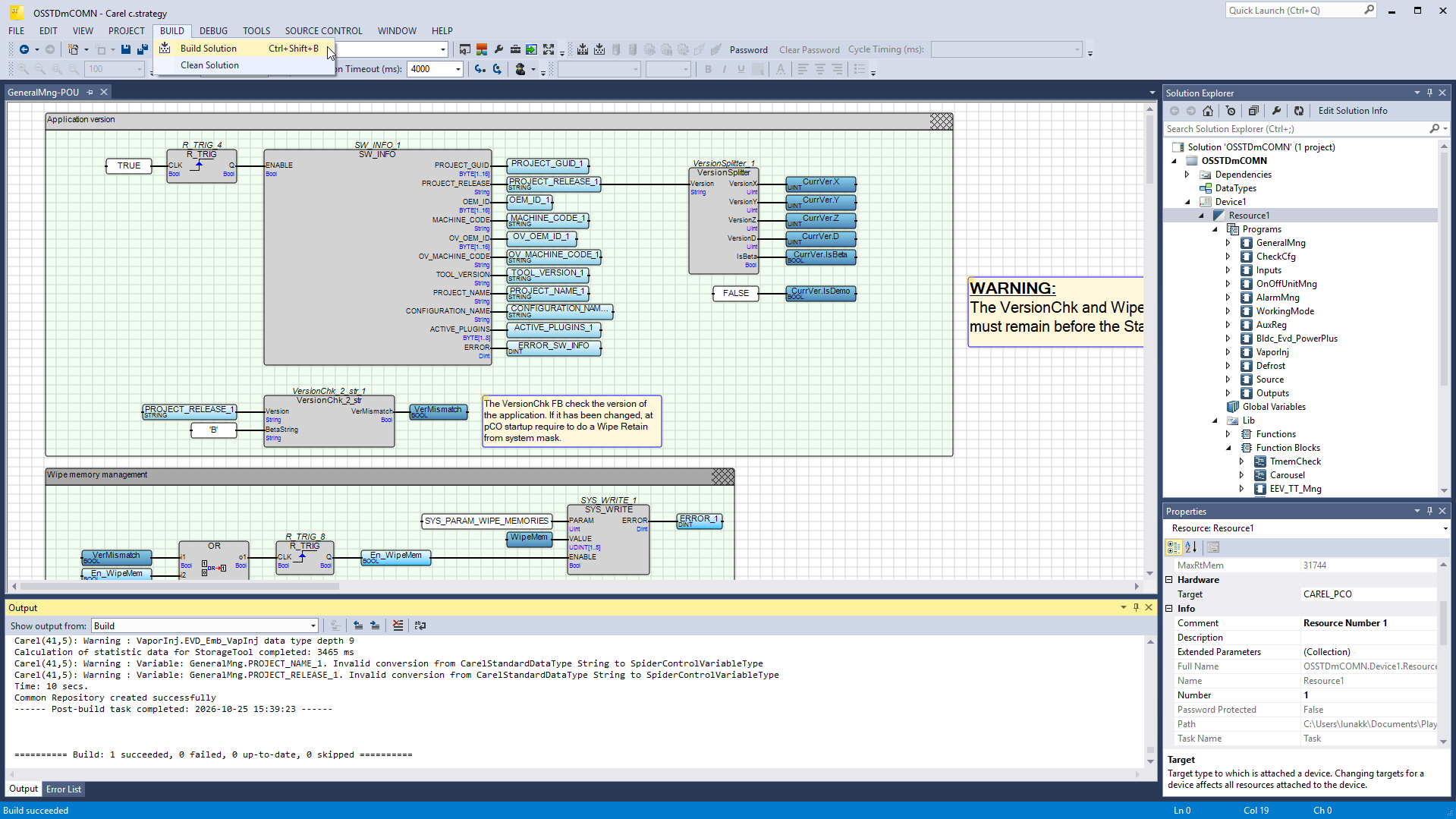
Export to STone lives in c.strategy and exports strategy, masks and alarms in one go. Sixteen seconds, 1 017 files, 39 520 lines of Structured Text, and a report: “Manual checks required: 252”.
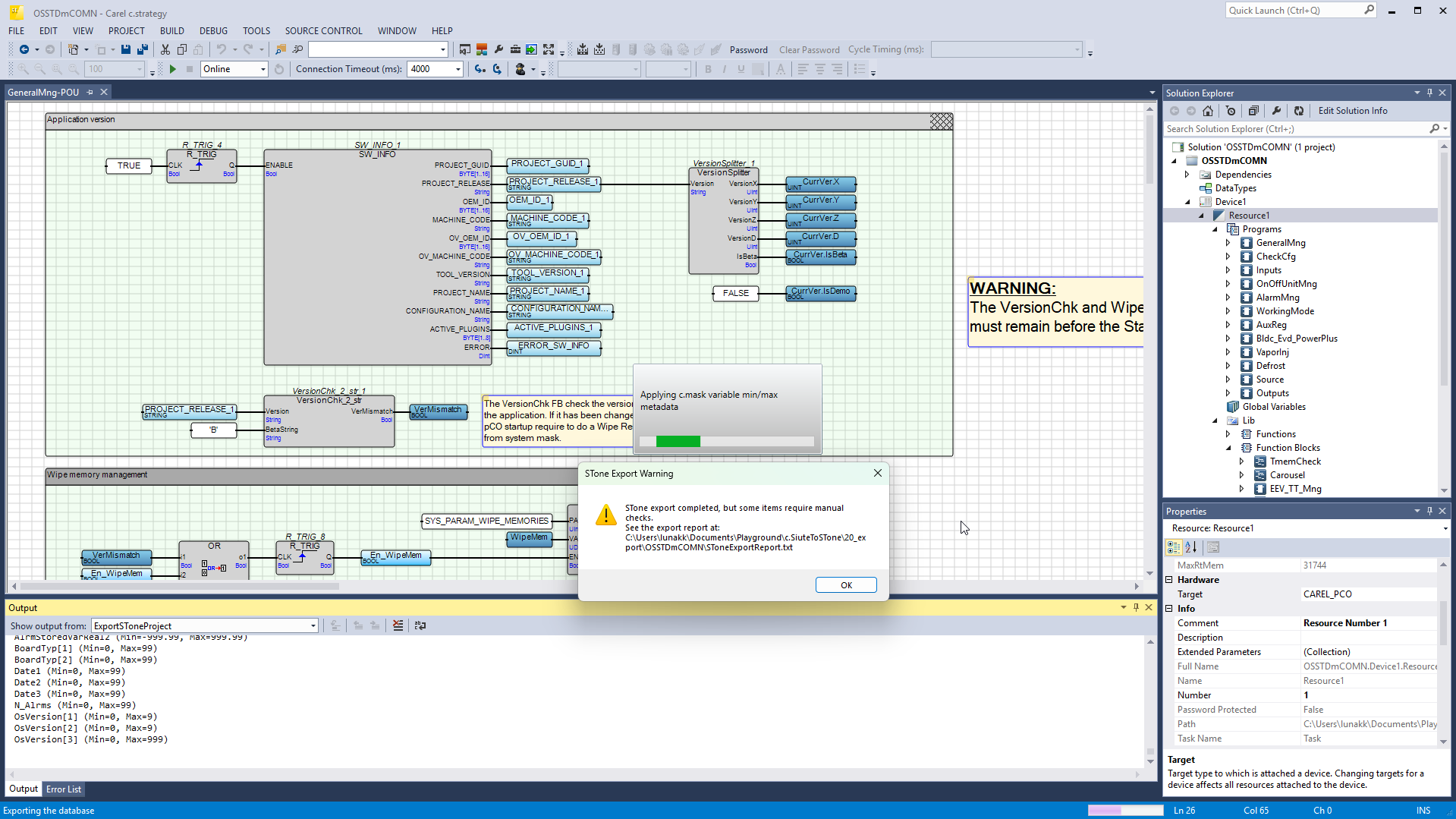
What the report says, in plain numbers:
| Report section | Count | Meaning |
|---|---|---|
| Libraries | 227 | Every CAREL library POU (Comp_BLDC, InverterPowerPlus, EVD_Emb, COMP_MNG_LIB) is exported as a declaration without a body, because the library is password protected |
| c.mask functions | 4 | Compare, IncrementDigit, DecrementDigit, GotoRightDigit have no STone equivalent |
| Min/Max metadata | 17 | field limits not exported |
| Alarms | 3 | informational: DINT timestamps valid until 2038, disabled alarms keep their code slot |
| Strings | 1 | “c.suite strings are zero‑based, STone strings are one‑based. Review user code.” No list of places. |
What the report does not say: one application POU, ValvePID, was password protected too and was silently skipped. Not a line about it. I found out when STone complained that the type did not exist.
Now the good news, because there is real good news:
- FBD → ST works. 49 of the 63 FBD blocks came out as readable Structured Text with zero warnings. The other 14 are library stubs (12), one duplicate and one that was lost. The style is function‑call heavy (
BooleanOR(...),NE(...),ADD(...)) rather than idiomatic ST, but the logic is there. - Masks and texts are faithful. All 242 masks, 286 special‑field definitions, 158 bitmaps (the application’s 117 plus the exporter’s own). I compared every text field with the original: 1 264 of 1 264 identical. The CAREL pGD1 font glyphs (
°,→,℃) were correctly mapped to Unicode. - Alarms came out as a proper STone
System.Alarmtable with 161 entries. - The BMS Modbus map (750 points) appeared as a STone
.protocfgfile, which the release notes do not even mention.
Step 3: first build in STone, 849 errors
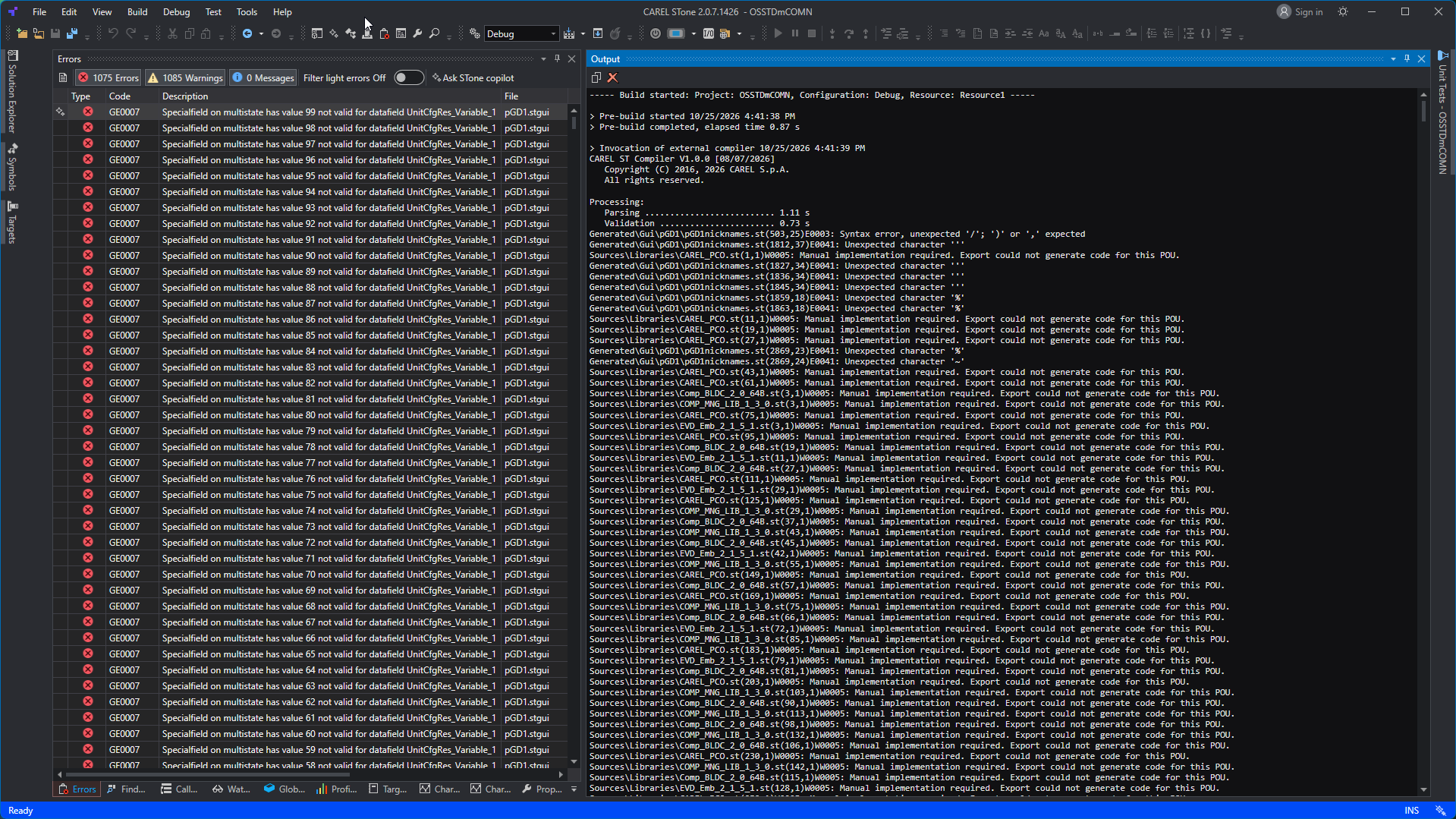
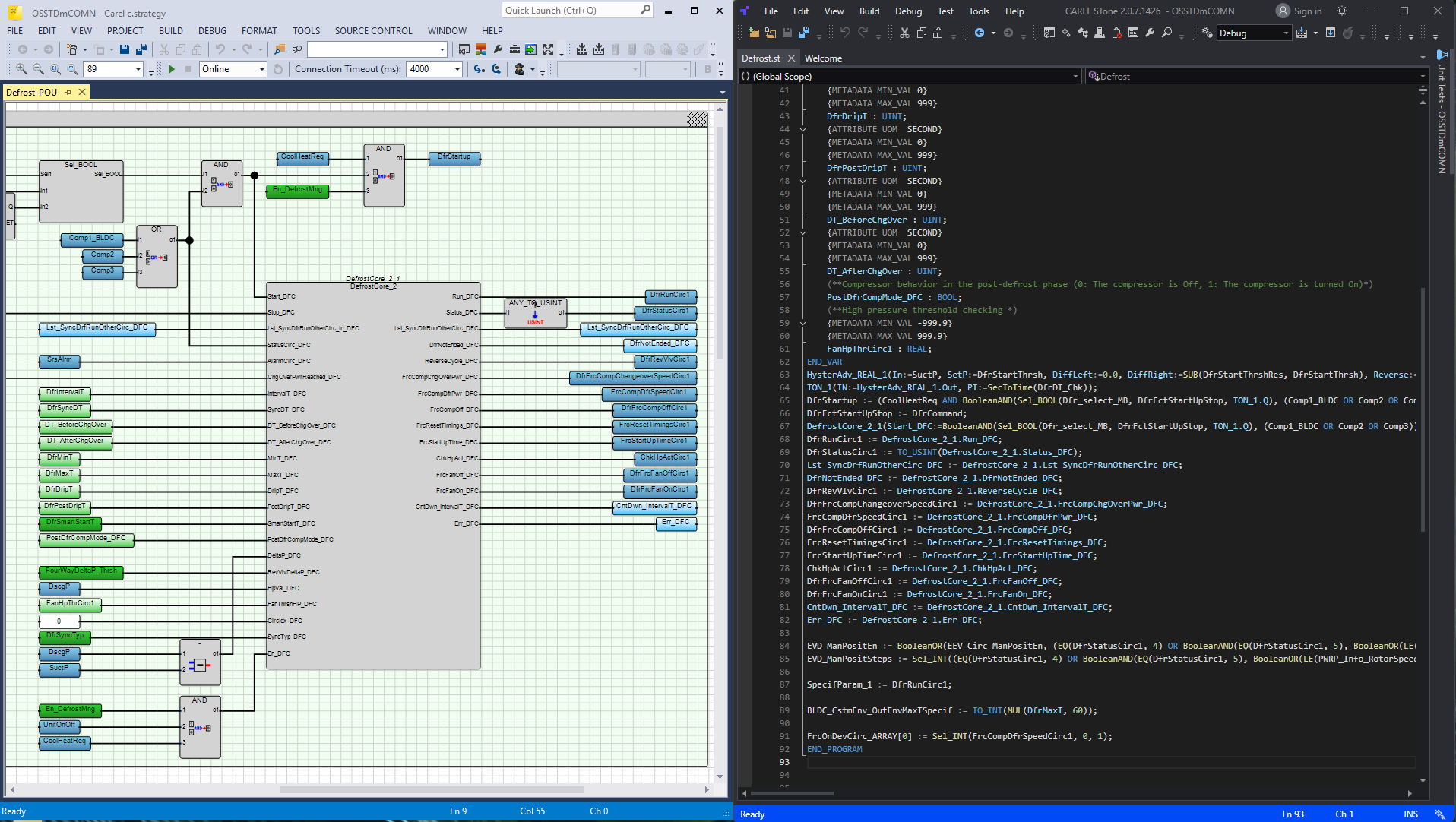
849errors in the first STone build, sixteen seconds after the export
This is the screen a c.suite engineer sees after the export (the cover picture above). Then the hunt starts, and this is where the days go.
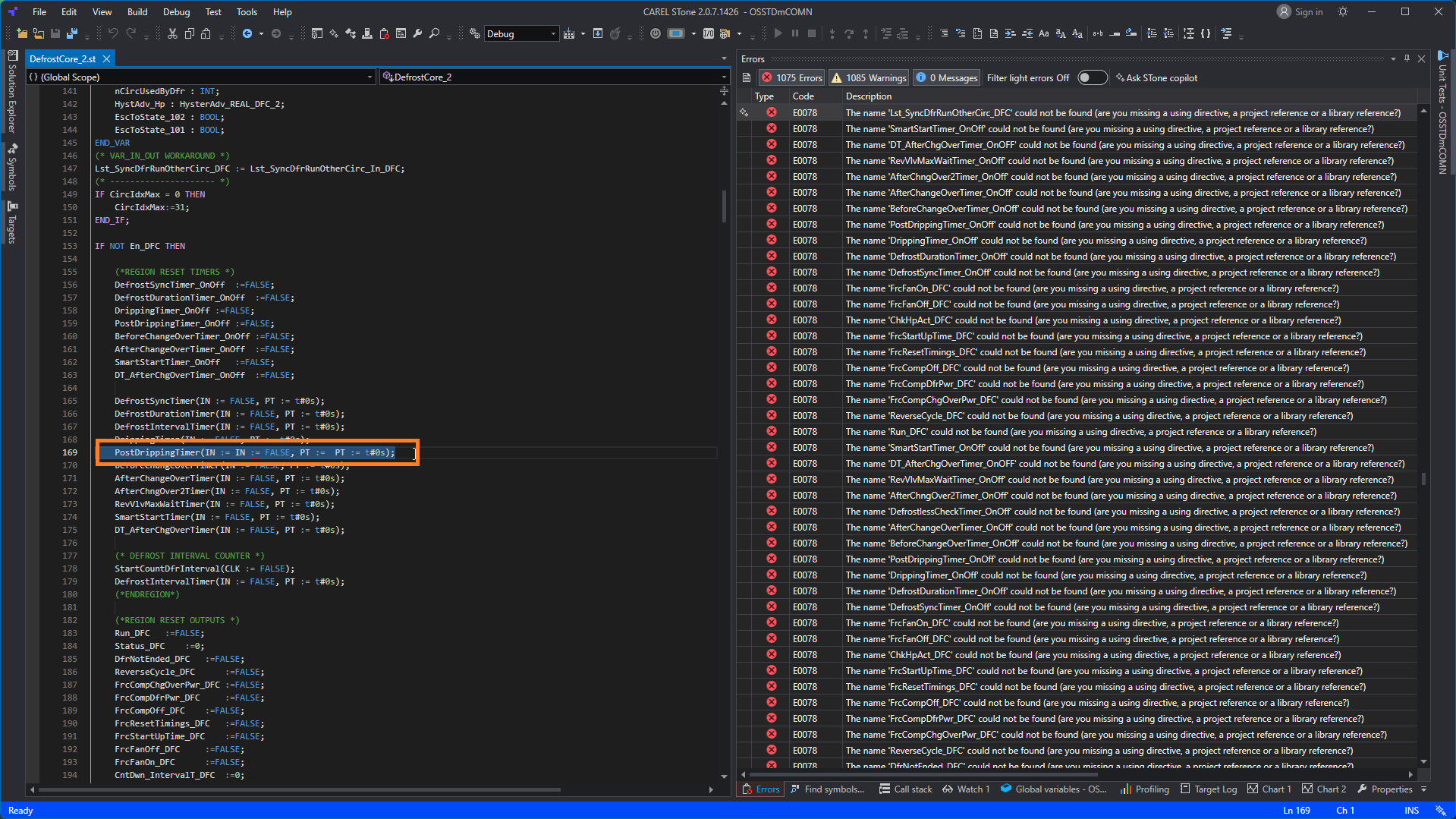
610 of the 849 errors come from one line. The exporter wrote IN := IN := FALSE in DefrostCore_2.st. The parser gave up on the whole function block, and every later reference to that block’s outputs became “name could not be found”. Nothing in the error list points at the cause.
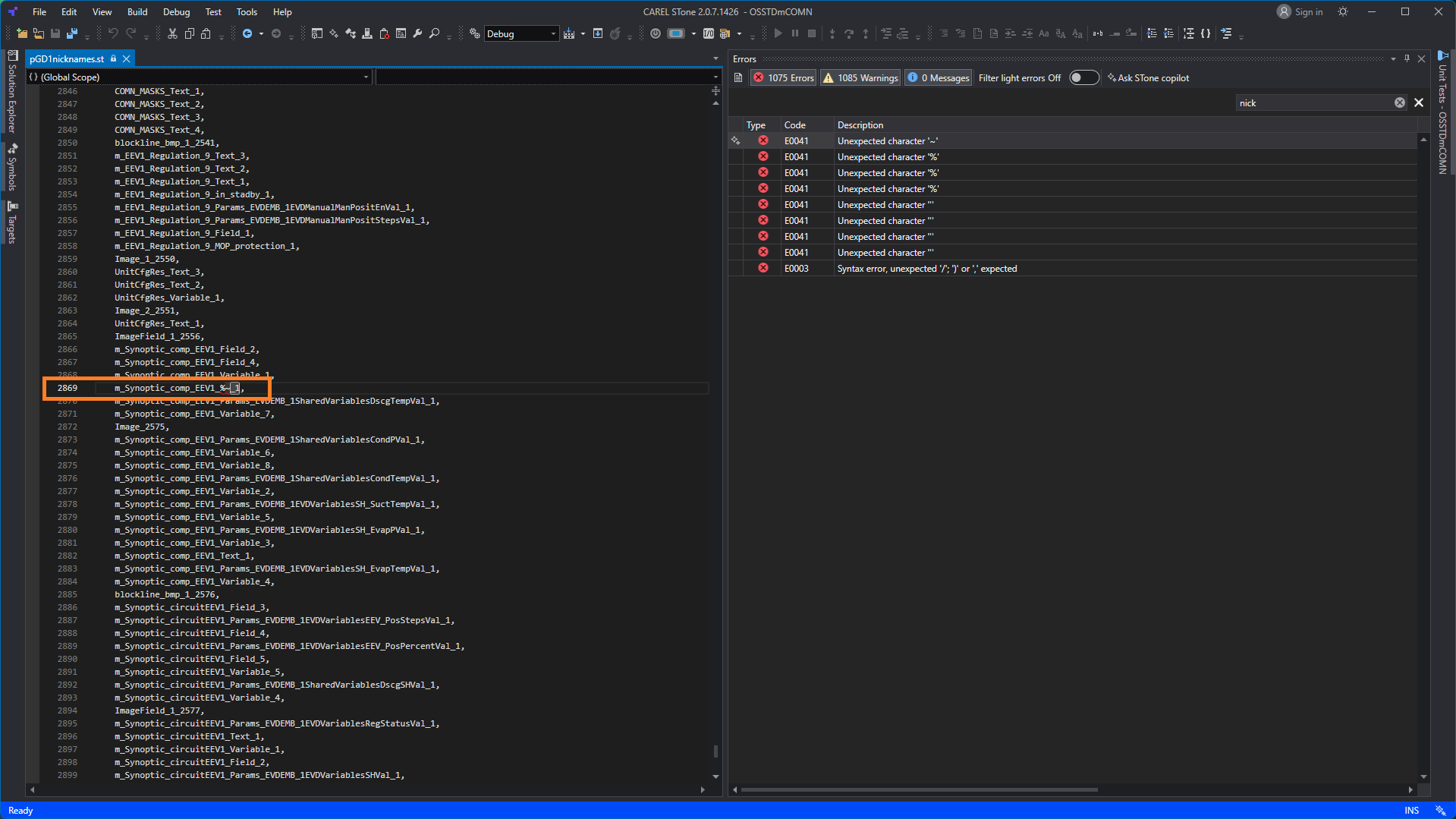
Nine errors are in a file that is not in your project. pGD1nicknames.st is generated by STone during the build from the mask field names. c.mask accepted field names like Ingressi/Uscite, Power+, Hz/s, % and velocita'; STone turns them into enum identifiers and chokes. 54 fields in 48 masks to rename, by hand, in XML.
The rest is a long tail; the biggest items are below. Each one is small, and each one needs you to understand a c.suite/STone difference that is documented nowhere:
| Errors | Cause | Fix |
|---|---|---|
| 82 | bit access Var.3 on INT/UINT; STone allows it only on BYTE/WORD/DWORD | retype to WORD, add conversions |
| 29 | BooleanOR(a, b, c): the FBD block had three inputs, STone’s function takes two | rewrite as a OR b OR c, 37 places |
| 17 | GotoLoop (Main) with a space before the parenthesis was not translated | pGD1.GotoLoop(pGD1_LoopList#MAIN) |
| 7 | the exporter’s own c.mask template declares StoredMask, and so does the application’s Code.st | rename |
| 6 | SR flip‑flop pins SET1/RESET instead of STone’s S1/R | rename |
| 6 | unconnected FBD pins: an argument silently dropped (Sel_BOOL called with 2 of 3 inputs) or exported as a wire id (Reset := id25) | guess the intended default, mark TODO |
| 3 | SEL(cond, 6, SEL(...)) ambiguous because of untyped literals | UINT#6 |
| 1 | NE(bool, bool) has no overload | <> |
| 1 | end_while in lowercase | uppercase |
Three passes later: 0 compiler errors. I did it with small Python scripts over the text files, which is the only reason it took hours and not days. 148 edits for this part alone.
Step 4: the compiler is happy, the build is not
Compilation is clean, and the post‑build still fails. The Output window shows two things: a message about “resource text length exceeds the available space limit”, which looks like an error but is only informational, and 222 lines of Specialfield on multistate has value N not valid for datafield …, with no file and no line number.
It took me longer to find this one than all 849 compiler errors together. The cause is not in the masks at all. STone takes a data field’s Min/Max from the variable’s {METADATA MIN_VAL/MAX_VAL}. The exporter wrote those from the c.mask field format: a one‑digit output field became MAX_VAL 9. But the c.mask classes behind those fields have 22, 100 or 338 text states. STone drops every state outside 0..9 and then reports each one as an error. Widening the Min/Max attribute in the mask XML does nothing; the fix has to go into the ST declaration of the variable or into the state lists. 189 more edits.
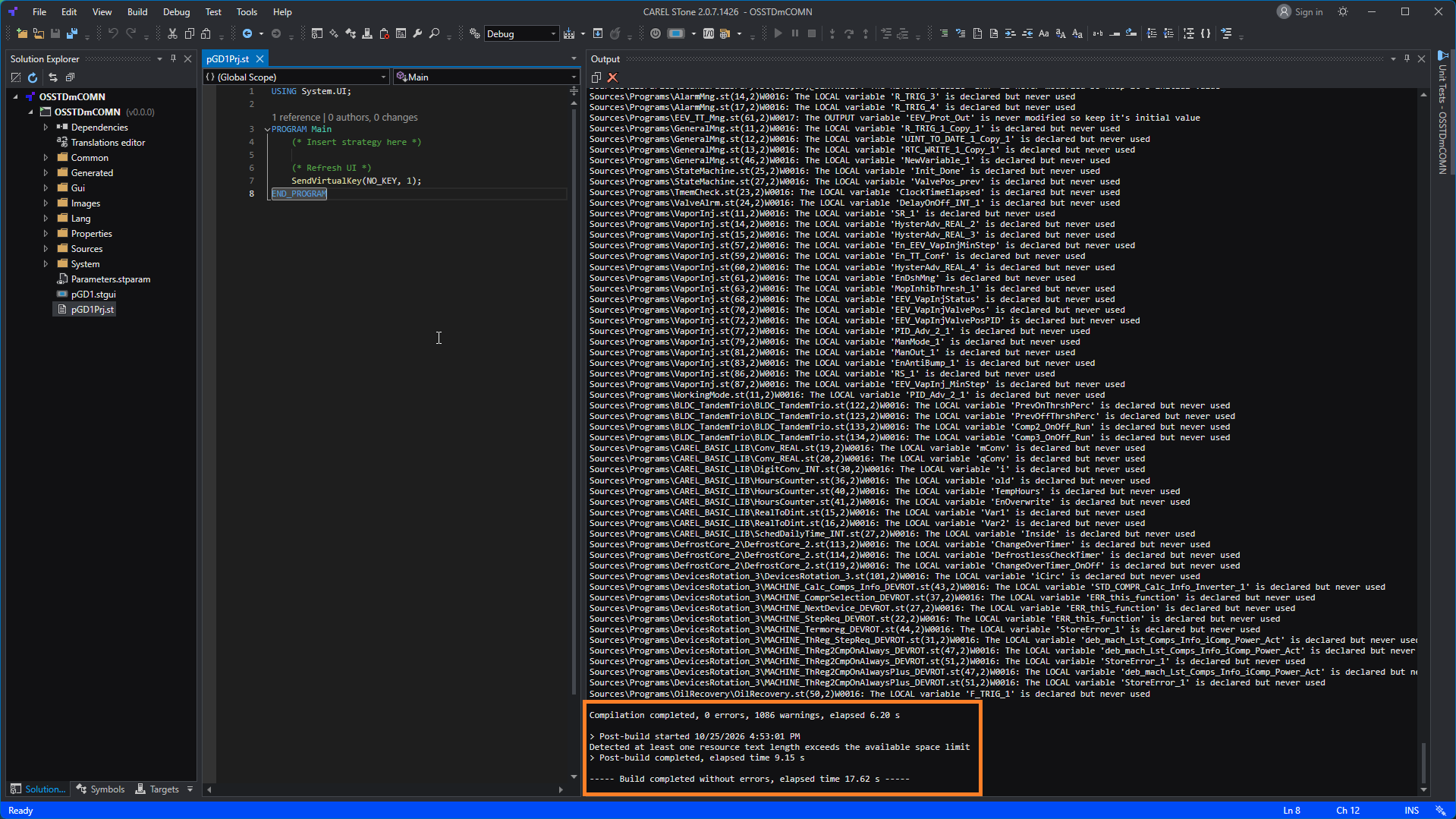
384edits in 263 files and 8 builds to get from 849 errors to Build completed without errors and a 601 KB flash.bin: 148 for the compiler, 189 for the GUI metadata, the rest for mask names and translations
Step 5: “green” is not “working”
Download to the PC‑Simulator. The main task crashes in the first PLC cycle.
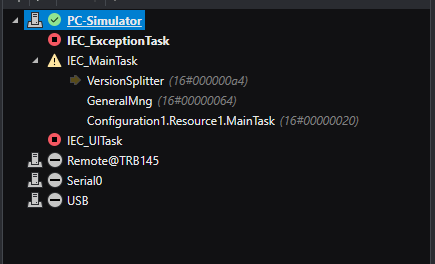
First crash: VersionSplitter, called from GeneralMng. The chain: SW_INFO is one of the 11 c.pCO system function blocks (NVRAM, SYS_READ, RTC, DATE_TO_UINT, EXPORT/IMPORT_PARAMS, …) that the exporter leaves empty. So PROJECT_RELEASE is an empty string, FIND returns 0, LEFT(s, -1) throws. In c.suite this line has run since 2014.
I implemented SW_INFO by hand. Rebuild, download, second crash, this time printed on the pGD1 itself:
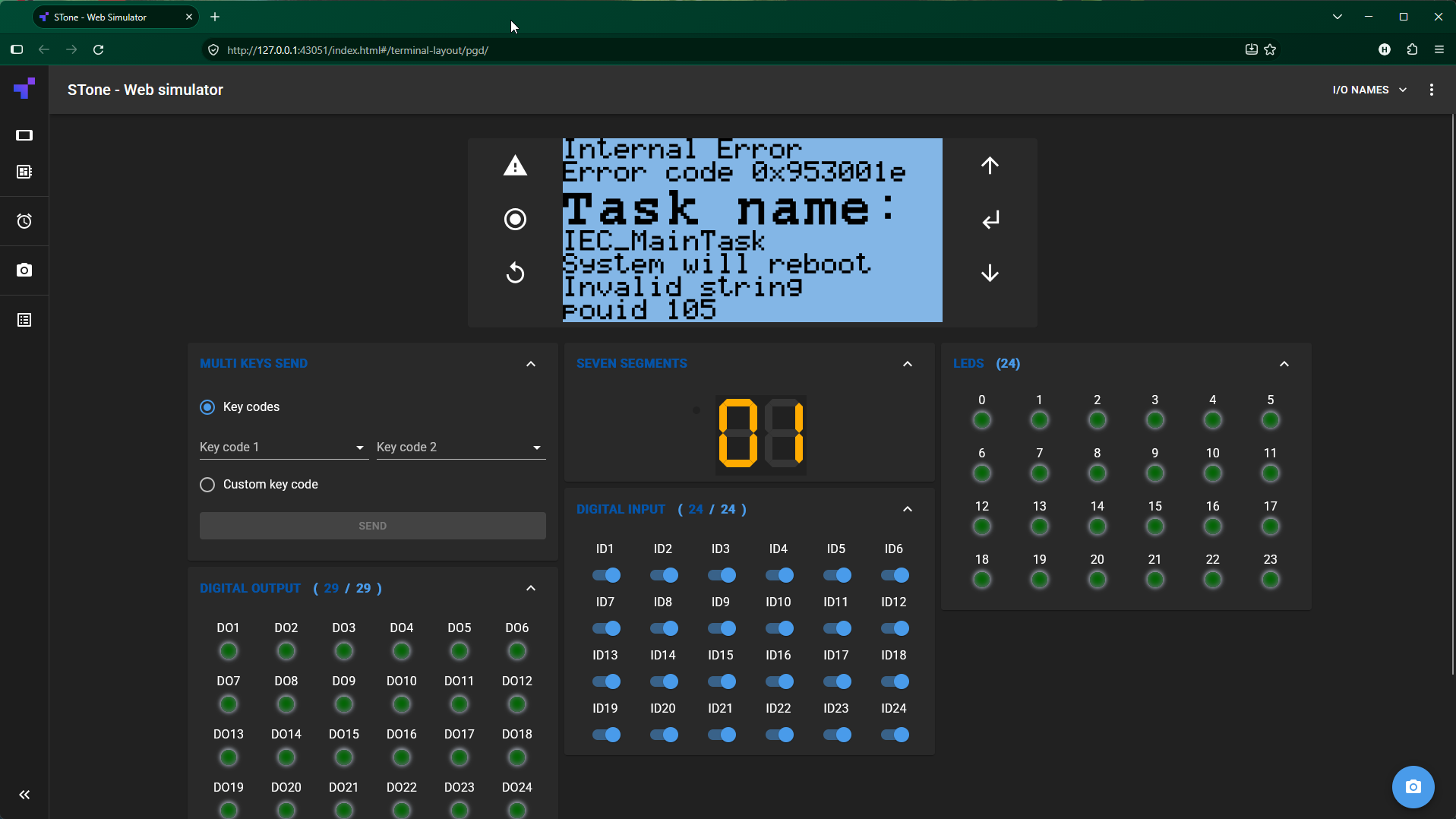
Internal Error
Error code 0x953001e
Task name: IEC_MainTask
System will reboot
Invalid string
pouid 105   pou offset 1740
No POU name, no line. pouid 105 maps through the build’s generation.xml to PROGRAM_GeneralMng, and offset 1740 through debug.xml to line 166:
EXPORT_PARAMS_1(..., FILENAME := INSERT('EXPORT_', TO_STRING(ImpExpFileName), 8));
Position 8 in a seven‑character string. In c.suite, whose string positions start at zero, this call has worked for years. In STone, where they start at one, it is past the end of the string. It compiles without a warning. The export report warned about string indexing in one generic sentence; this application has 26 such calls, and every one of them needs a human to read it.
I stopped here on purpose. Every one of the 344 empty declarations (the 227 library POUs from the report, 69 c.pCO system blocks and 48 c.mask functions) and every string call is another one of these, and they surface one per reboot.
0 / 242masks reached in the PC‑Simulator
The part no export can do: the libraries
The compressor, the inverter and the valve are not in the exported code at all. Can you just drop in the STone versions of the same libraries? I built a probe project with Comp_BLDC 8.3.2, InverterPowerPlus 6.5.1 and EVD_Emb 4.0.0 and compared the interfaces with what the application calls:
| c.suite FB | STone library | Matching input/output names |
|---|---|---|
Comp_BLDC, 17 inputs, 36 outputs | Comp_BLDC, 10 inputs, 14 outputs | 0 |
InverterPowerPlus, 16 / 17 | InverterPowerPlus, 10 / 14 | 0 |
EVD_Emb_2, 13 / 5 | no function block; EVD_Emb 4.0 is a set of classes | 0 |
0 %of input and output names shared between the c.suite function blocks and the STone libraries that replace them
The STone libraries are new designs, and EVD_Emb moved to OOP. On the c.suite structures of those three libraries hang 480 of the 1 003 mask fields (123 of 242 masks), 335 of the 750 BMS points and 80 of the 161 alarms. Replacing the libraries means re‑binding half of the HMI, half of the BMS map and half of the alarms. That is not a library swap. That is the second half of a rewrite.
What it costs in days
My estimate for one experienced OEM engineer who knows c.suite, is learning STone on the job, and has only the IDE and the documentation, with no scripts:
| Phase | Days |
|---|---|
| From 849 errors to a clean compile, including the 222 invisible GUI errors | 3–4 |
| Replace Comp_BLDC, InverterPowerPlus, EVD_Emb and re‑bind masks, BMS, alarms | 5–8 |
Re‑implement the 11 c.pCO system functions, the password‑protected ValvePID, the lost FBD pins | 2–3 |
| c.design: BMS, pGDx, I/O, logs, profiles, parameters (only the Modbus map comes out in STone form) | 2–4 |
| Functional test of 242 masks and 161 alarms on the pGD1 | 2–3 |
| Total | about 3–4 weeks |
For an application that c.suite builds in two and a half minutes.
So, export or rewrite?
The export is worth running. It saves you from retyping 4 400 lines of application ST, 10 500 lines of the CAREL libraries that are not password protected (DevicesRotation, CAREL_BASIC_LIB and friends), 242 masks, 161 alarms and a 750‑point Modbus map, and it translates FBD better than I expected. Run it, keep the output as a reference, mine it.
But do not plan a project around “export, fix the errors, ship”. The exported project is a starting corpus, not a port. Everything that made the c.suite application work (the CAREL libraries, the c.design configuration, the system functions, the zero‑based string habits) is either empty, missing or silently different, and the tooling tells you about it one crash at a time.
If you have twenty c.suite applications, the honest plan is: export all of them, keep the shared logic you wrote yourself, and design the STone version as a new application around the new libraries, with classes instead of the global‑variable function‑block style. The export gives you the material. It does not give you the building.
If you need a working application, not an exported one
Everything above I have already done once, with the scripts, the logs and the decoded errors that the IDE does not explain. If you have a c.suite application and want it in STone as a running program rather than as 849 errors to read through, get in touch. You will save dozens of hours on just getting the export to run. Whether the exported code then behaves correctly is a separate question, and it has to be answered on your application, not on the reference one.
Method notes: everything above was done with c.suite 5.3.18, STone 2.0.7 and the PC‑Simulator on one bench. The counts come from the build logs and from small Python scripts that parse the exported text files: project, masks, language file and build reports. Nothing proprietary was opened. The full table of numbers is longer than this post; ask if you want it.